
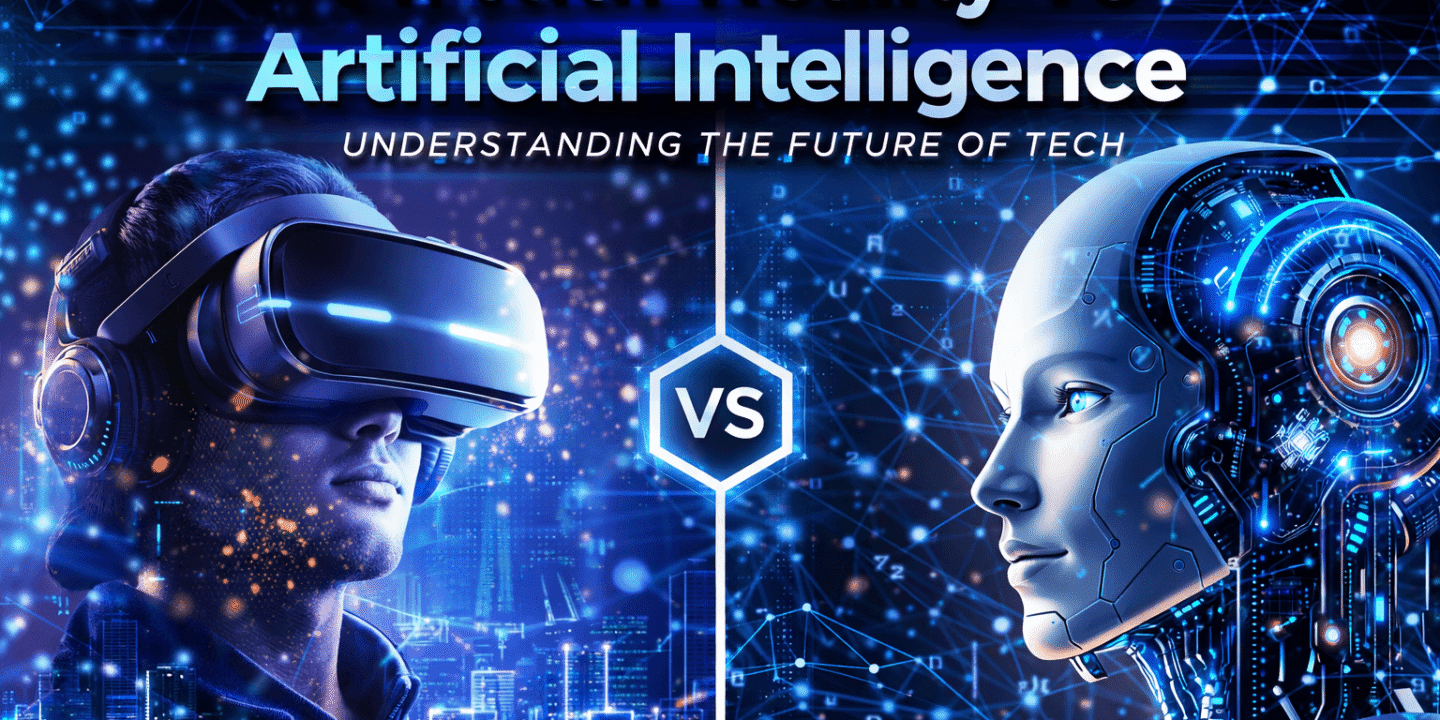
Virtual Reality vs Artificial Intelligence Technology: Understanding the Future of Tech
Explore the differences, similarities, and future potential of Virtual Reality (VR) and Artificial Intelligence (AI) technologies. Discover how they are reshaping industries and revolutionizing human experiences.
Virtual Reality vs Artificial Intelligence Technology: Understanding the Future of Tech
As technology continues to advance at a rapid pace, two fields stand out for their immense potential and transformative impact: Virtual Reality (VR) and Artificial Intelligence (AI). Both VR and AI have captured the imagination of tech enthusiasts, businesses, and consumers alike, as they promise to revolutionize various industries from gaming and entertainment to healthcare, education, and beyond.
In this article, we will explore both Virtual Reality and Artificial Intelligence technologies, examine their differences, and understand their implications for the future.
What is Virtual Reality (VR)?
Virtual Reality (VR) is an immersive technology that enables users to interact with a computer-generated environment. By using VR headsets or smart glasses, users can experience 3D visuals, sounds, and even haptic feedback, making them feel as though they are physically present in the virtual world. The primary goal of VR is to create a sense of immersion, where users feel fully engaged in the experience.
Key Features of VR:
- Immersive Environments: VR creates a fully immersive digital world that feels real.
- Real-Time Interaction: Users can interact with the virtual environment in real-time, such as through hand controllers or motion sensors.
- Simulated Sensory Experiences: VR can simulate sight, sound, and touch, providing a lifelike experience.
Applications of VR:
- Gaming: The gaming industry has embraced VR to create interactive and immersive experiences for players.
- Healthcare: VR is used for surgical simulations, pain management, and rehabilitation.
- Education: Virtual classrooms and simulations allow students to learn in a more engaging environment.
What is Artificial Intelligence (AI)?
Artificial Intelligence (AI) refers to the simulation of human intelligence processes by machines, especially computer systems. AI enables machines to perform tasks that typically require human cognition, such as learning, reasoning, problem-solving, language understanding, and decision-making. AI systems use algorithms and data to improve their performance over time.
Key Features of AI:
- Machine Learning (ML): AI systems learn from data and make decisions without being explicitly programmed.
- Natural Language Processing (NLP): AI understands and processes human language, enabling interaction with users through speech or text.
- Automation: AI can automate repetitive tasks, reducing the need for human intervention.
Applications of AI:
- Healthcare: AI assists in diagnosing diseases, drug discovery, and personalized treatment plans.
- Finance: AI is used for fraud detection, credit scoring, and algorithmic trading.
- Customer Service: AI-powered chatbots provide instant customer support and handle queries.
Virtual Reality vs Artificial Intelligence: Key Differences
While VR and AI are both groundbreaking technologies, they serve different purposes and work in distinct ways. Here are the key differences between VR and AI:
| Aspect | Virtual Reality (VR) | Artificial Intelligence (AI) |
| Core Technology | Creates immersive digital environments | Simulates human intelligence and learning |
| User Interaction | Users actively interact with virtual environments | AI systems make decisions autonomously or through interaction |
| Applications | Gaming, education, healthcare, entertainment | Healthcare, finance, customer service, automation |
| Technological Approach | Focuses on immersion through sensory simulations | Focuses on decision-making, learning, and data analysis |
| User Experience | User-focused and immersive | AI systems operate autonomously but can enhance user experience through interaction |
How VR and AI Complement Each Other
Though VR and AI are distinct technologies, they are increasingly being combined to enhance user experiences and revolutionize industries. Here are some examples of how VR and AI complement each other:
- AI-Enhanced VR Experiences: AI can be used to create more intelligent and adaptive VR environments. For example, in gaming, AI can control non-player characters (NPCs), making them react intelligently to user actions.
- AI in Virtual Training Simulations: VR is used for immersive training simulations, and AI can be integrated to adapt the difficulty levels or scenarios based on the trainee’s performance, providing a personalized learning experience.
The Future of VR and AI Technologies
As both VR and AI continue to evolve, their potential to reshape the future grows exponentially. We can expect to see more advanced VR experiences that incorporate AI, such as intelligent virtual assistants and adaptive learning environments. Additionally, AI will play a pivotal role in refining VR simulations, making them more responsive and realistic.
Trends to Watch:
- AI in VR Healthcare: AI-powered VR simulations will play a crucial role in medical training, enabling doctors to practice surgeries and diagnosis in a safe and controlled virtual environment.
- Improved VR Hardware: As AI improves, VR hardware will become more advanced, offering more realistic sensory experiences, such as AI-driven adaptive haptic feedback systems.
FAQ: Virtual Reality vs Artificial Intelligence
What is the main difference between VR and AI?
The main difference is that VR is an immersive technology that creates simulated environments, while AI is a system that simulates human intelligence to perform tasks autonomously.
Can VR and AI be used together?
Yes, VR and AI can be integrated to create more interactive, intelligent, and immersive experiences, such as in gaming or virtual training simulations.
How does AI impact VR experiences?
AI enhances VR experiences by controlling intelligent virtual environments and adapting to user actions, making the experience more engaging and realistic.
What industries benefit the most from VR and AI?
Both technologies are transforming industries such as healthcare, education, gaming, finance, and customer service by improving training, simulations, and automation.
What is the future of VR and AI?
The future of VR and AI includes more immersive experiences, smarter applications in various industries, and advancements in AI-driven VR simulations for training and entertainment.
Conclusion: The Intersection of VR and AI Technologies
Virtual Reality and Artificial Intelligence are two technologies that are not only changing the way we interact with the digital world but are also working together to create more immersive and intelligent experiences. As VR continues to revolutionize entertainment and training, and AI powers the next wave of innovation in automation and decision-making, the future looks bright for both technologies.
By understanding their differences and exploring how they complement each other, we can better appreciate the transformative potential they hold for the future.

Review Title
There are many variations of passages of Lorem Ipsum available, but the majority have suffered alteration in some form, by injected humour, or randomised words which don't look even slightly believable. If you are going to use a passage of Lorem Ipsum, you need to be sure there isn't anything embarrassing hidden in the middle of text.
8.1
If you use this site regularly and would like to help keep the site on the Internet, please consider donating a small sum to help pay for the hosting and bandwidth bill. There is no minimum donation, any sum is appreciated - click here to donate using PayPal. Thank you for your support.
Pros
- Pors Item One
- Pors Item Two
- Pors Item Three
- Pors Item Four
- Pors Item Five
Cons
- Cons Item One
- Cons Item Two
- Cons Item Three
- Cons Item Four
- Cons Item Five









No Comments